Education
The Power of One: Sundar Iyer’s Journey from Spreadsheets to Chalkboards
For most of his life, Sundar Iyer navigated the world of finance with precision and purpose. A seasoned corporate professional based in Mumbai, he understood the logic of balance sheets, the rhythm of quarterly targets, the language of ROI. But everything changed the day he stepped into a weekend volunteer role at a school for children with special needs. “There was no childhood story, no personal trigger,” he says. “It was just something I stumbled into — and couldn’t walk away from.”
What began as a weekend commitment slowly evolved into something far deeper. Every Saturday and Sunday, he would trade boardrooms for classrooms. These weren’t children who always spoke in words — some used gestures, some were non-verbal, some communicated with just their eyes — but every encounter left a mark.
“It was the experience of being there that planted the seed,” Sundar reflects. “You start seeing what no one else has bothered to see — the potential, the spark, the sheer dignity of their effort.”
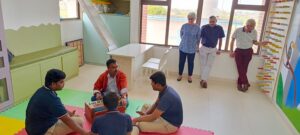

By 2010, that seed had grown roots. With two friends, he started Suryoday Trust in Nallasopara — not with a grand building or media launch, but with three rented shops and six students. Awareness of special needs was minimal in the area. Many parents hadn’t even heard terms like autism or intellectual disability. Some considered their children ‘uneducable.’ Others felt investing in them was futile. Sundar and his team went door to door, convincing families to give education a chance. “We weren’t just asking for trust,” he says. “We were challenging a lifetime of stigma.”
Fees were nominal — less than 15% of actual costs. Transportation was subsidised. Over time, word spread. Local doctors, therapists, and schools began referring children. By 2022, Suryoday operated out of 14 rented units. Then came the turning point — a purpose-built school building, opened in 2024, with support from RBL Bank and community donors. Today, the school serves over 105 children, with a vocational training centre in Bhayandar supporting another 25.
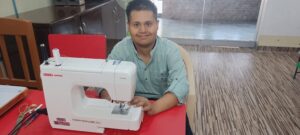
But Sundar insists Suryoday was never about infrastructure. “We weren’t building a school. We were building belief.” Each child, starting at age four, is placed in one of five levels — Early Intervention, Primary, Secondary, Pre-Vocational, or Vocational — based on NIEPID (National Institute for the Empowerment of Persons with Intellectual Disabilities) guidelines and internal evaluations. From age 12 onwards, children begin vocational exploration — housekeeping, IT, crafts, catering — and by 18, they graduate into full-fledged training.
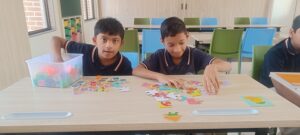

Certificates are optional. Life skills are not. “Parents wanted NIOS certificates,” Sundar says, “but we realised certificates don’t guarantee jobs. What matters is confidence, consistency, and employability.”


For students who cannot travel independently or whose families cannot support full-time employment, Suryoday is bringing work to them. Local employers are being onboarded. Home-based models are being explored. One initiative — Project Unnati — has students designing mugs, bags, and stationery that are sold through partner networks. The earnings go straight to the children. “Some earn ₹3,000 to ₹5,000 a month,” says Sundar. “It’s not charity. It’s income. It’s identity.”
What makes Suryoday unique is the ecosystem. Donors are not visitors. They’re collaborators — often participating in classroom sessions and pre-vocational activities. Teachers are required to have a B.Ed. in Special Education. Trustees are accountable — each must raise at least ₹3 lakh a year through donations or networks. “It’s not about wealth,” Sundar clarifies. “It’s about ownership.”

In 2018, Sundar digitised the NIEPID curriculum with support from an IT firm. The goal? To automate IEPs (Individualised Education Plans), track progress, and ease the administrative load. The platform supports 14 Indian languages and could soon be adopted nationally. An MoU with the Ministry of Social Justice is already in place, with rural schools receiving it for free and urban ones paying a nominal fee. “It’s about scaling quality,” Sundar says. “If we want inclusion to work, it has to be efficient.”
Sundar’s systems thinking has also shaped succession planning. With most trustees now over 60, a younger advisory board has been formed. Even the principal — a certified special educator — is being mentored for a future board role.
“This isn’t about me,” he says. “The work must outlast the founder.”
And yet, his presence lingers in every corner of the school — in the meticulous planning, the empathy-first culture, the high standards. He knows the children by name. He still joins donor visits. He walks through classrooms, not as a founder, but as someone still moved by the smallest progress. “When a child uses a new word, or just sits through a session calmly — that’s everything.”
His dream is simple, but not small. To create a world where every child, regardless of ability, is seen. Where financial dignity is a right, not a reward. Where employment, therapy, and belonging are not extras, but essentials. “Even if a child isn’t conventionally employable,” Sundar says, “they deserve to earn, to contribute, to matter.”
What began as one man’s weekend experiment is now a full-scale movement. And it all started with belief — belief in children, belief in change, and belief in the quiet, unstoppable power of one.
Read the full story in our latest issue – Teacher Warriors 2025.